How to Select ASCO Solenoid Valves for Industrial Applications
How to Select ASCO Solenoid Valves for Industrial Applications
ASCO solenoid valve selection starts with the application, not just the model number.An ASCO model number is a useful starting point, but it is not the whole specification. Two valves that look similar may differ in function, port thread, coil voltage, pressure range or electrical protection. For a new installation or a replacement, the safest approach is to define the operating conditions first, then verify the complete model against the valve nameplate and current manufacturer documentation.
This guide covers the checks that matter most when selecting an industrial solenoid valve. It also points to examples in YOUPH Automation’s product catalog so you can compare the types of components available.
1. Start with the valve’s job
Identify what the valve must do when its coil is energized and when power is removed. A two-way valve generally controls flow through an inlet and outlet. A directional valve may need to switch air between supply, actuator and exhaust ports. “Normally closed” and “normally open” describe the valve’s state without electrical power; that state must suit the machine’s intended behavior during a power loss.
Do not select a replacement from its pipe size alone. For example, a valve used to control a pneumatic actuator needs its port arrangement and switching function checked as carefully as its connection size. The ASCO SCG551A001MS 24 VDC G1/4 solenoid valve is one product-page starting point for reviewing a pneumatic valve model, but the complete installed specification should determine whether it fits your circuit.
2. Confirm the medium and operating pressure
ecord the medium passing through the valve: compressed air, water, light oil or another specified fluid. Then check its temperature, cleanliness and compatibility with the valve body and seals. “Industrial solenoid valve” is a broad search term; media compatibility is what narrows the real selection.
Pressure needs more than one number. Check the minimum and maximum operating pressure, the pressure difference across the valve, and any conditions during startup or shutdown. Some pilot-operated designs require a minimum pressure differential to function correctly, while some direct-acting designs do not. Use the documentation for the exact model rather than applying a rule from one ASCO series to another.
For a high-pressure replacement inquiry, the ASCO 8223G003 1/2 NPT high-pressure solenoid valve illustrates why the full model and electrical marking must be checked together with the pressure requirement.
3. Match port size, thread and flow requirement
A connection marked G1/4 is not the same specification as one marked 1/4 NPT. Confirm the thread standard and port arrangement before ordering. Also check the required flow, orifice or Cv/Kv value where the manufacturer provides it. A matching nominal pipe size alone does not establish that a valve can deliver the required flow.
This matters especially when replacing a valve in an existing assembly: photograph the nameplate, note the markings on each port and check the available installation space. A G1/4 ASCO valve and a 1/4 NPT ASCO valve should not be treated as interchangeable merely because both use “1/4” in their descriptions.
4. Verify coil voltage and electrical details
Read the voltage and frequency from the installed coil or nameplate. 24 VDC, 230 VAC 50 Hz and 220 VAC 50 Hz / 240 VAC 60 Hz are distinct electrical specifications. Confirm the available supply, connector, wiring arrangement and any required enclosure or protection rating.
If only the coil needs replacing, identify the valve series and exact coil reference before ordering. A separate coil listing, such as the ASCO 43004869 24 VDC coil for the SCG 551 series, should be checked against the complete installed valve and coil markings. A similar-looking coil is not enough evidence of fit.
5. Check the installation environment
For outdoor, wet, dusty or potentially hazardous locations, examine the electrical enclosure and the certifications required by the installation. A product described as “explosion-proof” still requires a check of the exact model marking, applicable approval, installation method and site classification. The product title by itself cannot establish suitability for a particular hazardous area.
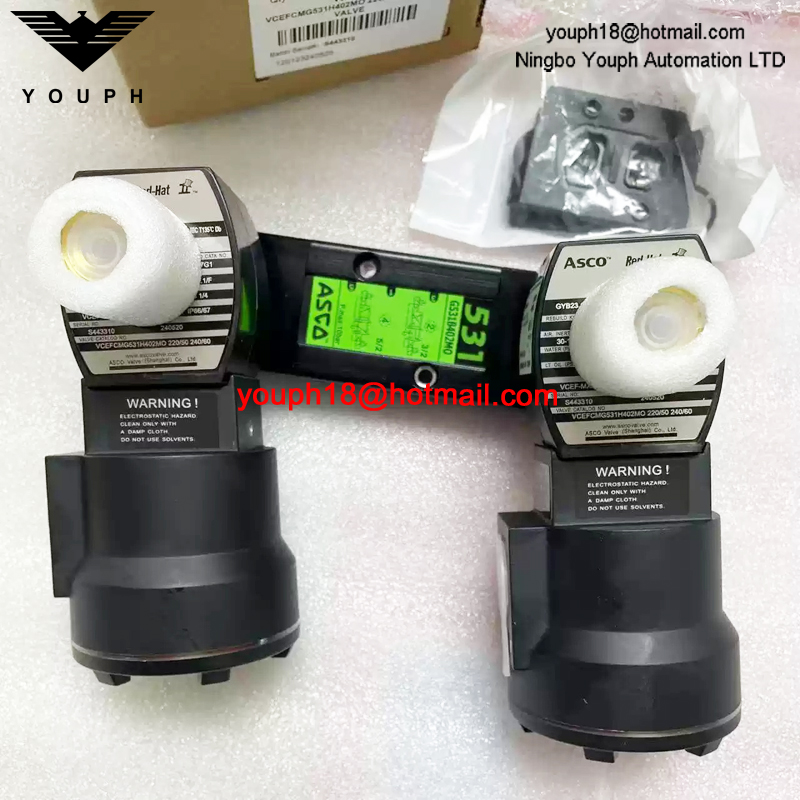
Examples in the catalog include the ASCO WSNF8327B102 24 VDC 1/4 NPT explosion-proof solenoid valve and the ASCO VCEFCMG551H401MO 24 VDC G1/4 explosion-proof solenoid valve. Their different port descriptions show why the complete suffix and nameplate matter.
6. Treat dust-collector pulse valves as a separate application
A reverse-jet dust collector needs short pulses of compressed air to clean its filters. Its pulse valve, controller and diaphragm components form part of a system; selecting a general-purpose process valve solely by matching voltage and port size would miss that application requirement.
The catalog includes an ASCO SCG353G047 G1-1/2 pulse jet valve, an ASCO WSNFG353D134 24 VDC explosion-proof pulse jet valve and an ASCO E909PB16MU1.3 dust collector pulse controller. For maintenance, an ASCO 97701879 diaphragm kit is listed separately. Confirm the installed series and part numbers before treating any controller or repair kit as a match. Emerson describes its 353 series specifically for reverse-jet dust collection. Source: Emerson ASCO 353.
A practical replacement checklist
Before requesting a quotation, gather:
- The complete model and part number from the valve and coil.
- Clear photos of the nameplate, ports and installed assembly.
- Valve function and its required state when power is off.
- Medium, operating temperature and pressure range.
- Port size, thread standard and required flow.
- Coil voltage, AC frequency if applicable, and connector type.
- Environmental conditions and any required certifications.
- Quantity, destination and whether you need a complete valve, coil or repair kit.
These details make it easier to distinguish close ASCO variants and avoid ordering a component based on a partial model number.
Request help with an ASCO model
YOUPH Automation lists ASCO valves and related components for industrial applications. Browse the current product catalog to find a model, then contact our team with the complete marking and operating requirements. We can review your inquiry against the listed product information; final suitability should always be confirmed against the exact unit and current manufacturer documentation.